

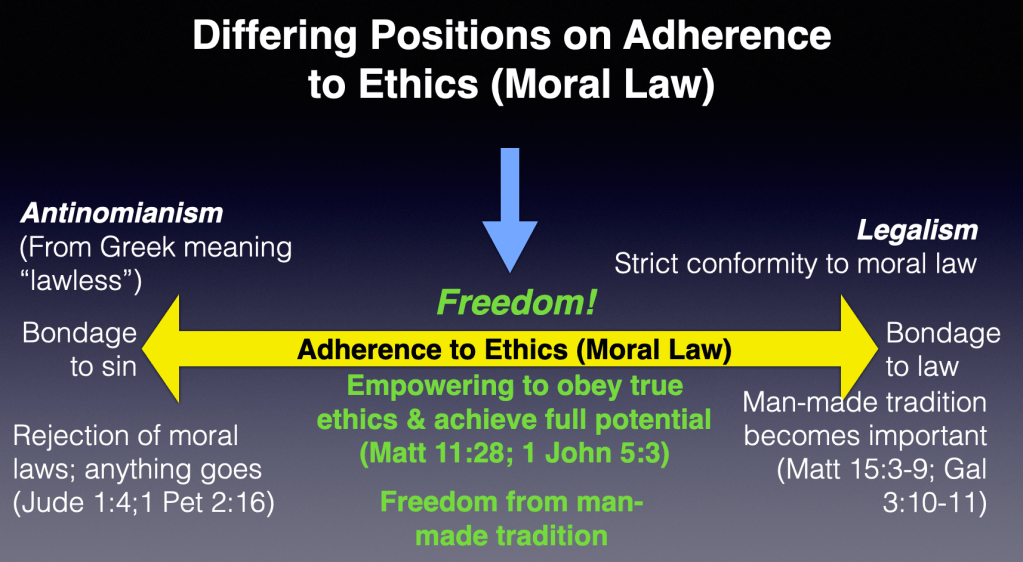
There are differing positions on adherence to Ethics (Moral Law) as depicted in the following figure. You want to be in the middle where true freedom exists.
Here are the characteristics of Christian Ethics:
- Jesus-centered
- Spirit-enabled
- Love-directed
- Oriented on Justice (rooted in the nature of God)
- Creational (moral law is embedded in creation in the grain of the universe)
- Objective (really there)
The ultimate goal of Ethics is enabling us to live for the glory of God (1 Cor 10:31.) It should not surprise us that God is concerned with more than just our behavior.
He is interested in us as whole persons, not just in the individual actions that we do.
He wants us not merely to do morally good actions, but He also wants us to be morally good people.
A life lived for the glory of God makes no distinction between “sacred” and “secular” – all of life is to be lived for the glory of God The distinction between “sacred” and “secular” arose out of the Enlightment and is a false dichotomy. JS Bach, regarded by many as the greatest musical genius in history, made no distinction between sacred and secular music; he viewed all music as for the glory of God.
The goal in Christian Ethics is conformity to the image of Christ (Rom 8:29.) Our goal must not be to cultivate right actions alone. We must also seek to develop a Christ-like character. It is a life-long process (Heb 12:1-2.) We become like Christ but do not lose our personal identity (2 Cor 3:18.) At justification, the back of sin is broken in our life and we are set free to reach our full potential as God originally created and intended. Our life should have productive results (fruit for the kingdom of God) [John 15:5.] A life lived according to Christian Ethics is not only one with Christ-like character, but also produces positive results.
Obedience is complex because life is complex. Obedience requires a dynamic personal relationship with Christ (John15:5.)
The dangers of legalism:
- Legalism regarding Justification says we are not justified by faith alone but by faith and works (Gal 2:16). What is the relationship between faith and works? Works are the result of true faith. Works are the result of sanctification (increasing ethical behavior), not the cause of justification.
- Legalism regarding moral commands of Scripture (Mark 7:9-13)
- Legalism regarding attitudes – (Phil 2:3)
- Legalism regarding emphasis – majoring on the minor things (Matt7:3-5)
There are various Ethical Positions on moral dilemmas:
- Antinomianism – no moral absolutes, moral conflict does not occur (must be rejected)
- Situationalism – situation ethics, only moral duty is to love; conflict cannot occur (must be rejected)
- Conflicting Absolutism – conflict can occur and someone must sin (must be rejected)
- Graded Absolutism – ethical norms are hierarchical; thus, one can obey the higher norm while breaking the lower norm without sin
- Nonconflicting Absolutism – moral norms cannot and do not conflict
Some Christian Ethicists support Graded Absolutism and it is gaining popularity among evangelical ethicists. “For example, in falsifying to save a life, it is not the falsehood that is good (a lie as such is always wrong), but it is the act of mercy to save a life that is good. . . . In these cases God does not consider a person culpable for the concomitant regrettable act in view of the performance of the greater good. . . . Graded absolutism does not believe there are any exceptions to absolute laws, only exemptions.” Geisler
In Graded Absolutism all ethical norms can be arranged in a hierarchy. When moral conflict occurs, resolution can be achieved by breaking a lower moral norm in order to keep a higher moral norm. Yet the hallmark of graded absolutism is its teaching that when a lower moral norm is broken in order to resolve a moral conflict, no sin has been committed. There are certain categories of moral laws that are higher than others – i.e., Love for God over love for humankind! Obey God over government, etc. Unavoidable sinful choices have their root in the corruption of man, not in the design of God. Geisler’s observation is wise – “Graded absolutism does not believe there are any exceptions to absolute laws, only exemptions.”
In Nonconflicting Absolutism, moral conflicts never occur. This is probably the prevailing view among Evangelical Ethicists who warn that the “Impossible Moral Conflict” view becomes a slippery slope that encourages Christians to sin more and more. They argue that for the Bible’s far simpler perspective: Obey God’s Commands and believe that Christians will never face an impossible moral dilemma.
I’m still wrestling with this and am currently leaning towards Graded Absolutism. When faced with a dilemma, a tough choice, we should not focus on the degree of ‘evil’ in the choice, but on choosing the good thing and doing the right thing. Ultimately we must recognize that the sovereign God is able to use evil for good. The greatest act of evil ever perpetrated – the crucifixion of Christ – resulted in the greatest good. To not act in love may be the true evil in the eyes of God (but there are no situational ethics.)
Part 5 is here

 Christian Apologetics
Leave a comment