

Here is the classic problem:
- If God is omnipotent, omniscient and omnibenevolent, he could and would prevent evil.
- Evil exists.
- Therefore God must not exist.
Most philosophers agree that Alvin Plantinga successfully refuted the logical problem of evil using the Free Will Defense; it is no longer considered a valid argument by most philosophers and theologians. Note this applies only to the logical problem of evil, not the evidential or existential problem of evil.
Here is the Logical Problem Of Evil answered:
1) An omnipotent, omniscient and all-good God would have both the power and will to prevent evil unless he has a morally sufficient reason.
2) Evil exists.
3) Therefore God must not exist.
The argument is now non sequitur (does not follow.)
Possible morally-sufficient reasons that have been offered by Christian philosophers and theologians to explain the coexistence of evil and God include: Free Will Defense, Natural Law Defense, Soul-Making Theodicy, Best-Of-All-Possible-Worlds Theodicy, Divine Judgment Defense, and the especially potent Greater-Good Theodicy and Greater-Glory Theodicy.
Examples of evil resulting in greater good:
- Gen 50:15-20 – 13 years passed between time Joseph was sold into slavery and he left prison
- The crucifixion of Christ – The greatest act of evil ever perpetrated brought about the greatest good (Acts 2:22-33)
There are multiple problems of evil. There are not one, but three problems . . .
1) Logical Problem (answered by Plantinga’s Free Will Defense)
2) Evidential Problem (The evidential problem of evil refers to the quantity and nature of evi; – i.e., why is there so much evil of a horrific nature?)
3) Religous (Personal or Existential) Problem (The existential problem refers to evil personally experienced [i.e., a mother whose child was killed by a drunk driver doesn’t need apologetics; she needs pastoral care]).
Your understanding of God will determine your perspective on evil. If your God is meticulously sovereign (Prov 16:33), then he permits evil for some morally sufficient reason.
Here are heretical positions regardng evil:
1) God does not know the future (Open Theism); he takes risks
2) God is changing (Process Theology) so evil is a natural occurence with no guarantee of immutable goodness
3) God is not omniscient (Prov 15:3) and evil can take him by surprise
4) God is not omnipotent; there is an eternal battle between good & evil (dualism)
But what about “gratuitous” evil? Not seeing a reason for a particular evil is not the same as seeing that there is no reason for that evil. Remember – skeptical theism dictates we can never know everything God knows. God will settle accounts justly for those who suffered horrendous evils and for those who committed horrendous evils.
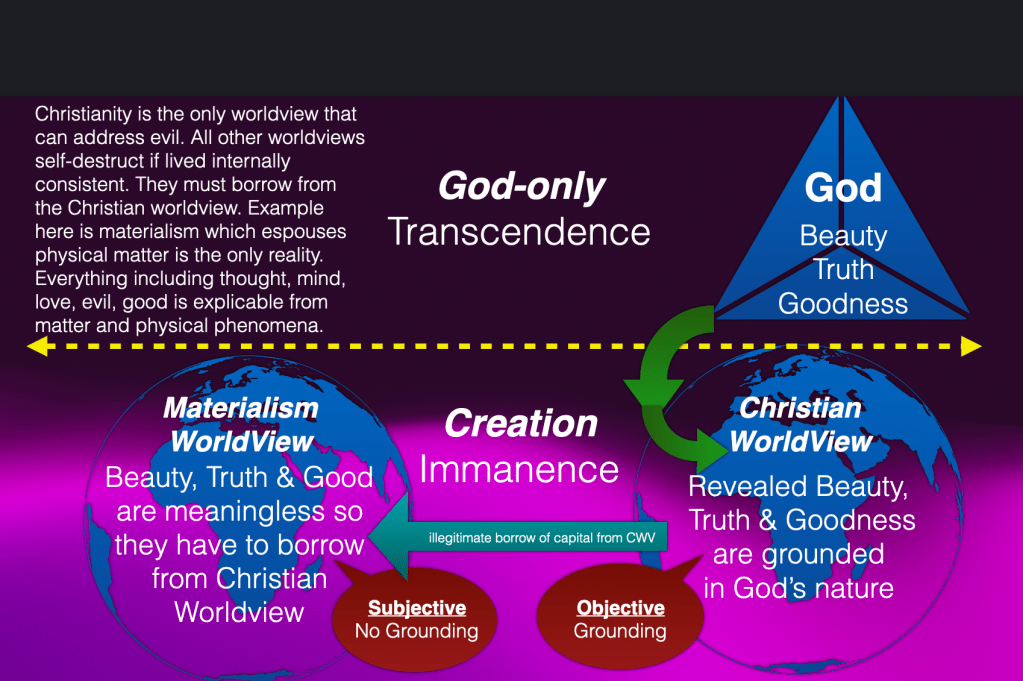
In fact, only Christianity can address evil. Ironically, the problem of evil turns out to be one of our strengths when other worldviews are forced to address it. Other worldviews “borrow capital” from the Christian worldview or self-destruct if they are stay consistent within their worldview and are forced to their logical conclusion. Evil can be a crucial fulcrum point in evangelism. Non-Christians are concerned about evil, justice, morality, yet they have no ground for it. Other worldviews illegimately borrow from the Christian worldview:
Part 3, the final part, is here

 Christian Apologetics
Leave a comment