

We do not posses any original manuscripts (autographs) of the New Testament, but copies of copies. Since we don’t have the original documents, two criteria become important to establish the reliability of the copies.
- How many different copies are there that can be compared?
- How far in time are the copies from the original?
The New Testament possesses the greatest number of manuscripts of any book from the ancient world. To better understand the scope of the numbers involved, as of 2017, the Institute for New Testament Textual Research, located at the University of Munster in Germany, currently lists the official number at 5,856 partial and complete manuscript copies written in the Greek language. This number increases every year as new manuscripts are discovered in museums, private collections and monasteries. These include handwritten copies of the New Testament papyri, parchment and lectionaries. If we add to this number more than 18,000 New Testament manuscripts written in other languages (translations) besides Greek, the overall count swells to nearly 24,000 New Testament manuscripts.
The earliest New Testament manuscript fragment we possess today is the John Rylands Fragment (also called P52) which contains a small portion of John 18. Most scholars date the fragment anywhere from AD 117–135, which, at its earliest, is only about 30 years removed from the original writing of the Gospel of John.
There are variations in these manuscripts, most of which are inconsequential spelling and grammatical errors (I will address the variations in detail in a future post). Two of the greatest textual scholars, Brooke Foss Westcott and Fenton John Anthony Hort, had this to say concerning the amount of variation in the New Testament manuscripts: “If comparative trivialities, such as changes of order, the insertion or omission of an article with proper names, and the like, are set aside, the words in our opinion still subject to doubt can hardly amount to more than a thousandth part of the whole New Testament.”
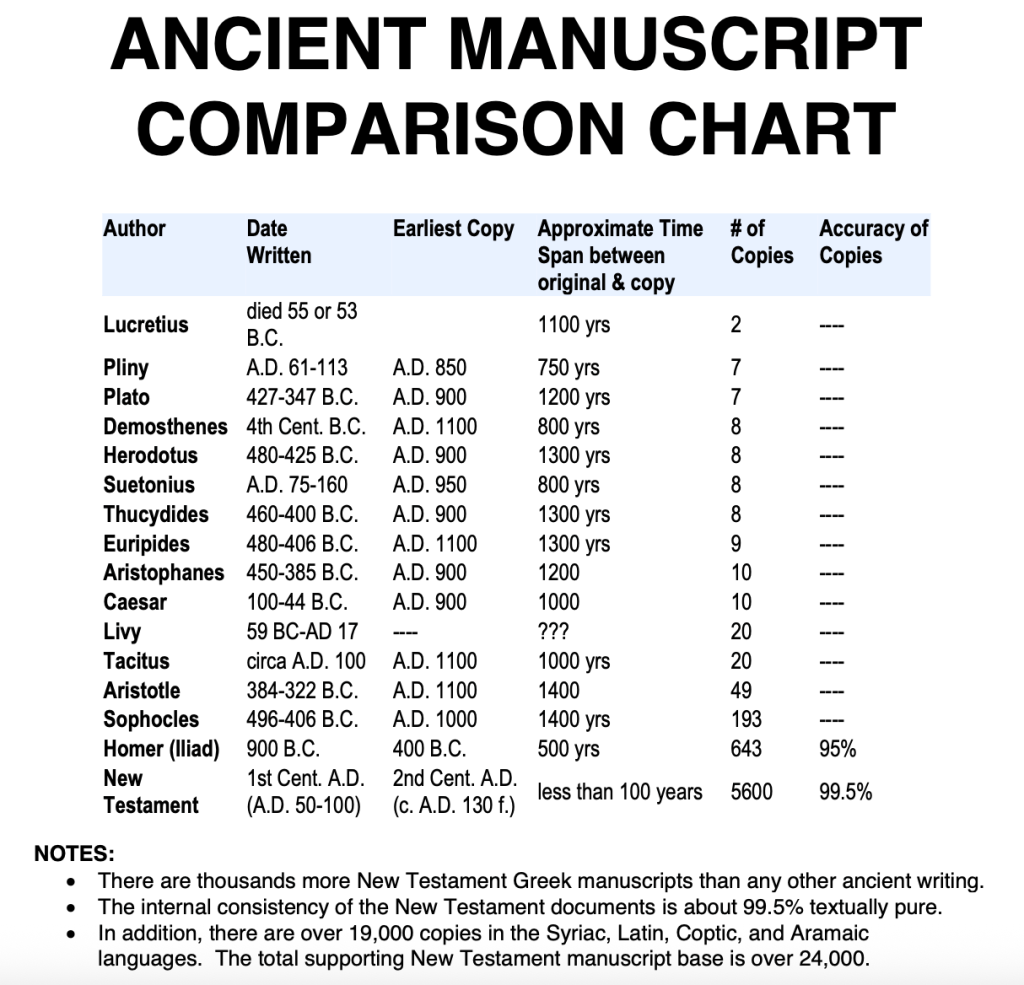
Here is a table comparing the manuscript authority for the New Testament and other ancient documents who are also all copies of originals. We see that the New Testament has the strongest manuscript authority of any ancient document. If we reject the New Testament as being faithful to the original autograhs, we must throw out every other ancient document and relegate accepted works (such as Caesar, Homer and Suetonius) to the trash.
SOURCE for following table: Christian Apologetics and Resource Ministry – https://carm.org/manuscript-evidence
 Christian Apologetics
Leave a comment