

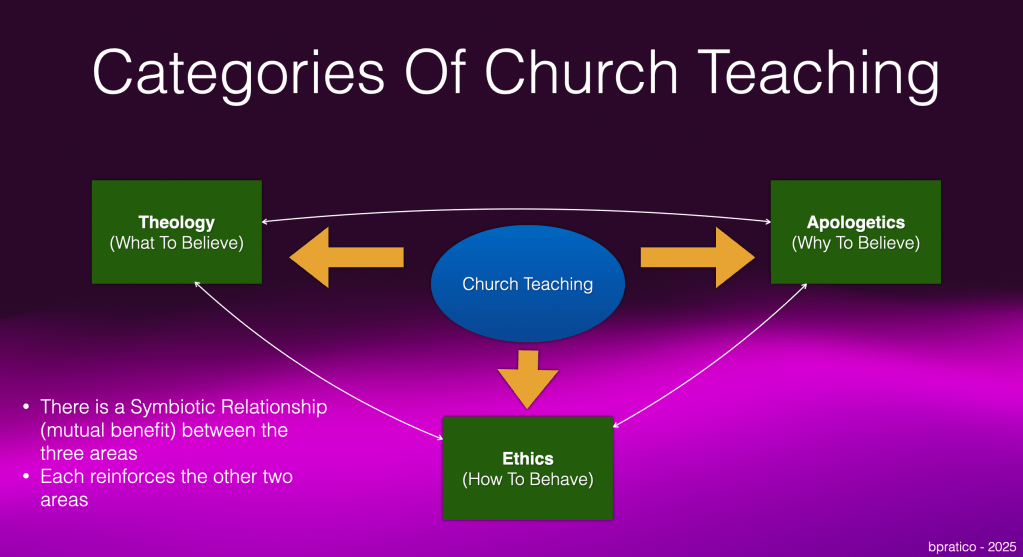
Church teaching has been historically divided into three categories: (1) THEOLOGY (what to believe), (2) APOLOGETICS (why to believe) and (3) ETHICS (how to act). There is a Symbiotic Relationship (mutual benefit) between the three areas, with each reinforcing the other two areas. If we emphasize one area to the exclusion of the other areas, we diminish the effectiveness of church teaching.
For example, if we teach theology in isolation from apologetics, then people won’t understand the rationality behind their faith, resulting in many leaving the faith when they experience serious pushback (Matt 13:21). (A recent study found a shocking 75% of Christian youth leave the church by their early twenties.) On the other hand if we divorce theology from ethics, there is no practical application for theological understanding. Theology merely becomes academic.
If we teach ethics in isolation from theology, there is no objective ground for ethical behavior and everything becomes relative. If we teach ethics in isolation from apologetics, Christians are not equipped to be the effective moral conscience of the culture. (The German Protestant Church, the church of Luther and the Reformation, capitulated to the Nazi Regime during the 1930s and failed its task of being the moral conscience for German culture. As a result, the country was destroyed during WW2 and suffered devastating division for 45 years.)
If we teach apologetics in isolation from ethics, people are being taught to merely win arguments instead of souls. If we teach apologstics in isolation from theology, there is no solid foundation to prevent drifting into error and heresy.
All three areas of teaching are important. There is a powerful symbiotic relationship between the three areas of theology, apologetics and ethics. Our teaching becomes more powerful and effective when we remember that and keep all three areas in mind.
 Christian Apologetics
Leave a comment